Friday, January 25, 2019
Punctuation Exploration
As writers, the students are working on understanding the purpose of conventions and using conventions throughout their writing. This week our crew discovered punctuation marks that authors use in books. The students read and noticed the various punctuation marks. Once they discovered a punctuation mark, they identified the purpose of the punctuation mark and how it helps readers. Together we generated a list of the various punctuation marks found in the text. Some of our favorite punctuation marks we have been excited to learn about include quotation marks, commas, and ellipsis. Next week, we will explore capital letters and apply these conventions to our writing using red "convention pens".
Thursday, January 17, 2019
Martin Luther King Jr.
Over the past two weeks, our crew has been learning about the life and dream of Martin Luther King Jr. We started by sharing what we knew and asked questions we were wondering. After reading many Martin Luther King Jr. books, we had powerful discussions on how Martin Luther King Jr. made a difference for the people in our country.
We also took some time to collaborate and create a word splash that symbolizes Martin's dream. We took all of our thoughts and created a whole class word splash that you can find below. Overall, we learned from Martin that love is greater than hate, as well as it is important to use courage to stand up for what is right. We hope to live by the messages Martin has taught us in our crew.
Thursday, December 20, 2018
Winter Holiday Party
Our crew spent the morning celebrating with one another at our Holiday party. The students had the best time participating in relay races, decorating snowmen, creating snowflakes, and eating tasty treats. The students talked about the party all day. A few even said, "This is the best day, ever!" :) Thank you to Jennifer for planning such a wonderful event for our crew! Also, thank you to all of those who volunteered and/or brought supplies to make this party a success. Happy Holidays from our crew to yours!
Thursday, November 29, 2018
Unwanted Candy!
After celebrating Halloween, our students learned of an exciting opportunity with I-Orthodontics in Lone Tree. For every pound of candy we donated, we would earn a dollar in return! All of the candy donated is given to local charities and those who did not get to trick or treat. After Ms. Crystal, Ms. Tina, and I dropped the candy off, we were informed our crew donated 72 pounds of candy. For this donation, we received 72 dollars to purchase something for our classroom!
The students collaborated to brainstorm a list of items to purchase. After having discussing budgets and wants vs. needs, the students decided the money would be best spent purchasing flag football belts, a roller vacuum, and dustpans. The students shared that during Togetherness there is confusion if someone is tagged or not. They decided if we wear these flags during Togetherness we will have less conflict over who was tagged. They also admitted that picking up scraps off the floor is an afternoon job they dread. By purchasing a roller vacuum and dustpans this job may be easier. I am so impressed with our crew's ability to think about spending the money in a useful way that can benefit our classroom. Thank you all for your donations, and thank you to I-Orthodontics for partnering with us!
Wednesday, October 31, 2018
Halloween Party
Our crew had a wonderful time celebrating Halloween together! We were able to show the school our costumes in the Halloween Parade. After the parade, we spent the morning enjoying delicious breakfast treats, decorating jack-o-lanterns and ghosts, and bowling with "ghosts". The students had an absolute blast! Thank you to Jennifer Giambrone for planning a great event, and thank you to all of the families that donated supplies and/or joined us for this celebration. This party would not have been a success without your support. Happy Halloween!
Friday, October 26, 2018
Non-fiction
Our crew is becoming experts on non-fiction in reading and writing!
As readers, we have read non-fiction books and discovered text features that authors include to help readers learn. We eventually will use these non-fiction text features to create a book about pond life.
For now, we are practicing these non-fiction text features as we read. This week, we focused on captions. The students wrote a caption to describe a photograph. We learned captions need to describe the photograph using facts and true information, as well as be interesting, short, and specific. We also spent some time comparing a table of contents and an index. We learned the table of contents shares the headings and pages numbers, and an index shares specific words in the text along with page numbers.
In writing, our students are learning to write informational text. As a class, we have discovered that informational text is text that teaches facts to readers. The students have been researching a pond life animal, writing facts, and creating their own informational text about the animal they are studying. We have discussed organization and sentence fluency. In the weeks to come, the students will begin adding a topic sentence, conclusion, and supporting details to the informational text they are composing.
Thursday, October 18, 2018
Fieldwork to Carson Nature Center
Our students visited Carson Nature Center today to participate in our second fieldwork with Ranger Beth. The students had the opportunity to visit wetland, the river edge, and grassland habitats to discover organisms. The students were able to discover the following information about each habitat:
Wetlands are sunny, wet, windy, and near water. Wetlands include any habitat that has shallow water. Organisms such as cattails, mice, ducks, and beavers live in this habitat.
The river edge is where the river meets the land. In this habitat, it is sunny, shady, wet, and windy. Organisms such as cottonwood trees, raccoons, mice, squirrels, ducks, rabbits, and beavers can be found in this habitat.
Grasslands are habitats that are large open areas of grass. This habitat is sunny, dry and windy. Tall and short plants, raccoons, mice, chipmunks, rabbits, and even snakes live in this habitat. (See if you can spot the snake in the photograph of grass below!) :)
Along with learning about different habitats, the students had the opportunity to learn about seed dispersal and pollination. The students discovered that some animals pollinate and others disperse seeds. Seeds can be dispersed through water, wind, scat, and even by connecting on to another animal's fur.
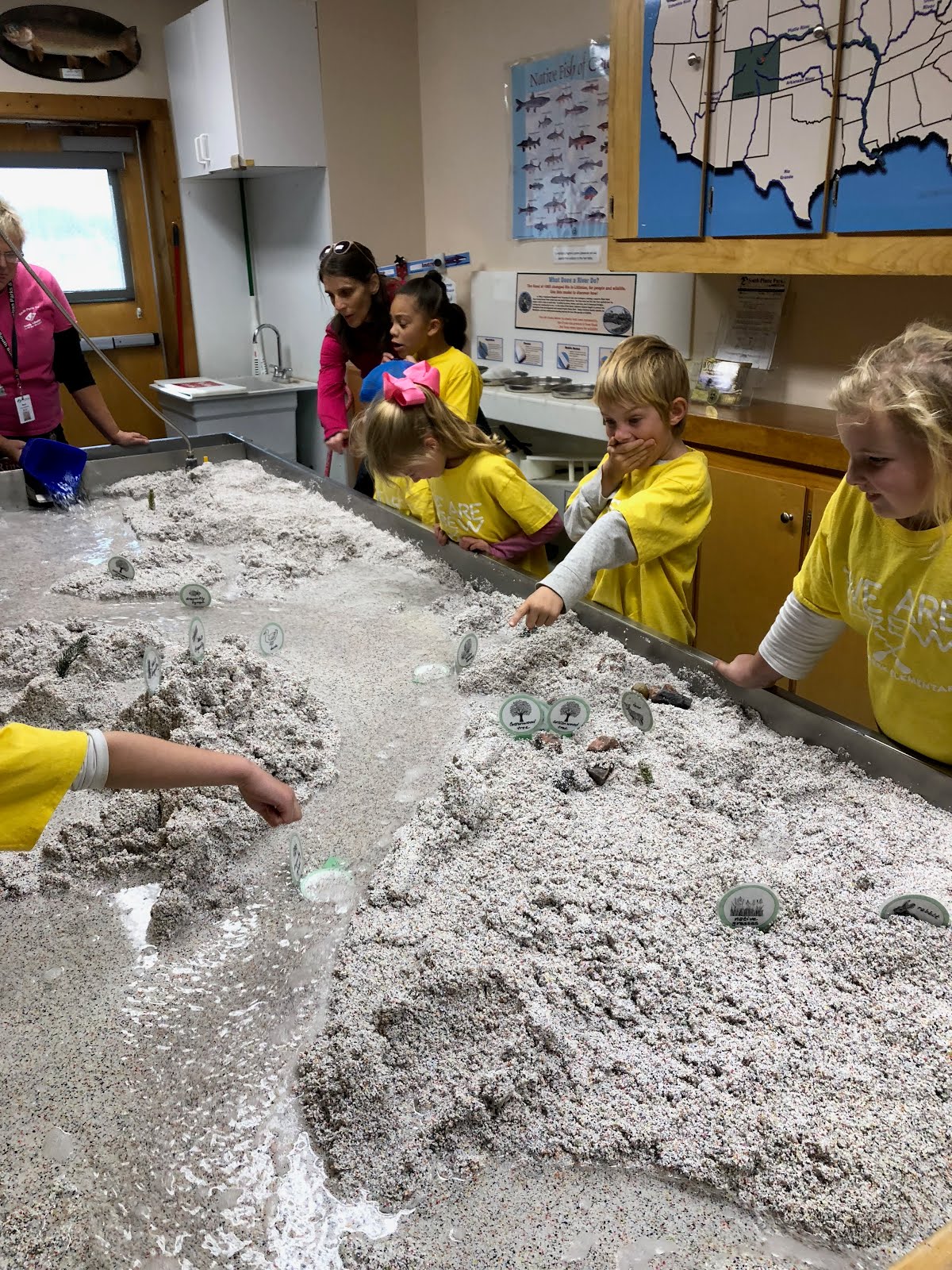
The students also had the ability to interact with a flood table. The students were able to place plants and animals in areas they believe would best survive. Once a flood appeared, the students noticed the flood affected the entire wetland and river edge! They moved animals and plants around to finally discover the best place for these organisms to thirve.
This fieldwork helped us learn about different habitats. In the weeks to come, we will compare these different habitats and discover how organisms survive and thrive.
Wetlands are sunny, wet, windy, and near water. Wetlands include any habitat that has shallow water. Organisms such as cattails, mice, ducks, and beavers live in this habitat.
The river edge is where the river meets the land. In this habitat, it is sunny, shady, wet, and windy. Organisms such as cottonwood trees, raccoons, mice, squirrels, ducks, rabbits, and beavers can be found in this habitat.
Grasslands are habitats that are large open areas of grass. This habitat is sunny, dry and windy. Tall and short plants, raccoons, mice, chipmunks, rabbits, and even snakes live in this habitat. (See if you can spot the snake in the photograph of grass below!) :)
Along with learning about different habitats, the students had the opportunity to learn about seed dispersal and pollination. The students discovered that some animals pollinate and others disperse seeds. Seeds can be dispersed through water, wind, scat, and even by connecting on to another animal's fur.
The students also had the ability to interact with a flood table. The students were able to place plants and animals in areas they believe would best survive. Once a flood appeared, the students noticed the flood affected the entire wetland and river edge! They moved animals and plants around to finally discover the best place for these organisms to thirve.
This fieldwork helped us learn about different habitats. In the weeks to come, we will compare these different habitats and discover how organisms survive and thrive.
Subscribe to:
Posts (Atom)